Form 1 Chemistry — Term 3
About Course
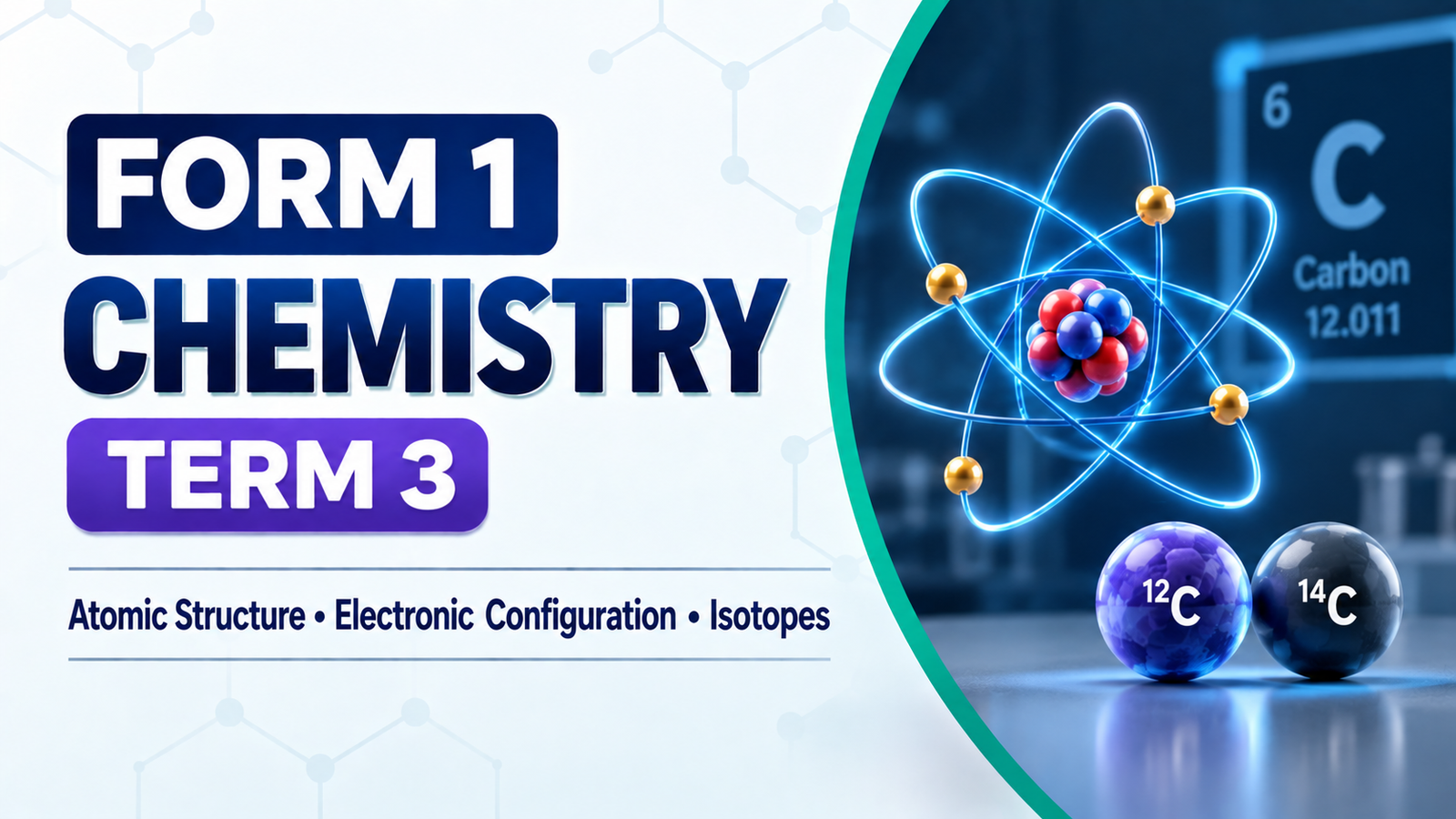
Form 1 Chemistry — Term 3 is a structured chemistry course designed to help learners understand the structure of the atom and how atomic structure explains the behaviour and classification of elements.
The course begins with Atomic Structure, where learners explore the development of ideas about the atom through important atomic models, including the models proposed by Dalton and Bohr. Learners will develop an understanding of the structure of an atom and how scientific models have been used to explain atomic structure.
Learners will then study the subatomic particles that make up an atom: protons, neutrons and electrons. They will identify these particles, describe their characteristics and understand their relative charges and positions within the atom. The concept of atomic neutrality will help learners understand how the numbers of protons and electrons are related in a neutral atom.
The course introduces atomic number and mass number, enabling learners to determine the composition of atoms and interpret information about elements.
Learners will also develop their understanding of chemical symbols and nuclide notation and learn how this notation provides important information about an atom.
A major part of the course focuses on electronic configuration. Learners will explore how electrons are arranged in shells around the nucleus and apply the duplet and octet rules when writing electronic configurations. They will practise drawing simple atomic structures and relate electronic configuration to the position of elements on the periodic table.
Learners will also use valence electrons and valency to help classify elements as metals and non-metals, strengthening the connection between atomic structure and the properties of elements.
The final learning area introduces the isotopic nature of elements. Learners will discover what isotopes are, calculate and interpret relative atomic mass and percentage abundance, and explore the uses and potentially hazardous nature of radioactive isotopes.
The course also introduces principles of safe storage and handling of radioisotopes, helping learners develop awareness of radiation safety and responsible scientific practice.
Through clear explanations, atomic diagrams, worked examples, guided practice, quizzes and assessments, learners will develop scientific reasoning and problem-solving skills while building an important foundation for future Chemistry studies.
Understand the atom. Master electronic structure. Think like a chemist.
Course Content
COURSE INTRODUCTION
-
Welcome to EduVersed Stream
-
How to Use This Course
-
Course Expectations
TOPIC 1 — STRUCTURE OF AN ATOM
TOPIC 2 — SUBATOMIC PARTICLES
TOPIC 3 — ATOMIC NUMBER, MASS NUMBER AND NUCLIDE NOTATION
TOPIC 4 — ELECTRONIC CONFIGURATION
TOPIC 5 — ISOTOPIC NATURE OF ELEMENTS
Student Ratings & Reviews