Form 1 Biology — Term 2
By charlesphiri2020
Categories: Form 1 Biology
About Course
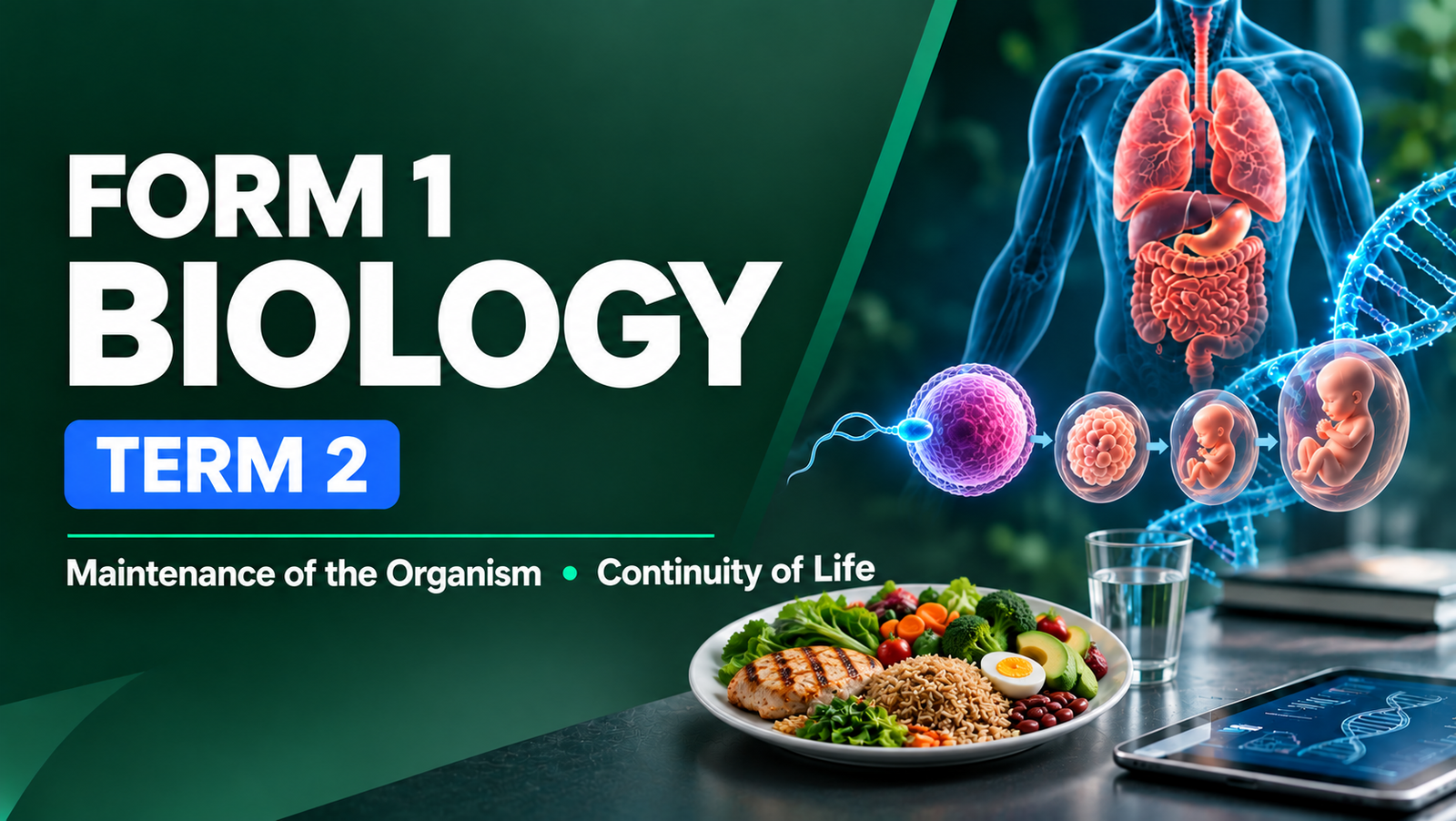
Explore how organisms obtain nutrients, maintain healthy growth, and reproduce. This course covers human and plant nutrition, nutritional deficiencies, reproduction in living organisms, human reproductive systems, and reproduction in microorganisms.
What Will You Learn?
- 🥗 Identify nutrients, their sources, and their importance in human nutrition.
- 🌱 Explain the role of mineral nutrients in plant growth and development.
- 🩺 Recognise common nutritional deficiency diseases and disorders in humans and plants.
- 🧬 Describe sexual and asexual reproduction in living organisms.
- 👨🔬 Explain human reproduction and reproduction in selected microorganisms.
Course Content
Section 1: Maintenance of the Organism
Topic 1: Nutrition in Man
-
Lesson 1 – Meaning of nutrition
-
Lesson 2 – Types of food nutrients
-
Lesson 3 – Classification of nutrients
-
Lesson 4 – Sources of food nutrients
-
Lesson 5 – Importance of nutrients in humans
Topic 2: Dietary Needs of Different Persons
-
Lesson 1 – Factors affecting dietary needs
-
Lesson 2 – Dietary needs of infants
-
Lesson 3 – Dietary needs of adolescents
-
Lesson 4 – Dietary needs of manual workers
-
Lesson 5 – Dietary needs of pregnant women
-
Lesson 6 – Dietary needs of lactating women
-
Lesson 7 – Dietary needs of sick or invalid persons
-
Lesson 8 – Dietary needs of the aged
Topic 3: Plant Nutrients
-
Lesson 1 – Mineral nutrients in plants
-
Lesson 2 – Essential plant nutrients
-
Lesson 3 – Macronutrients and micronutrients
-
Lesson 4 – Nitrogen, phosphorus and potassium (NPK)
-
Lesson 5 – Effects of NPK on plant growth
Topic 4: Nutritional Deficiency Diseases and Disorders in Humans
-
Lesson 1 – Meaning of nutritional deficiency
-
Lesson 2 – Kwashiorkor
-
Lesson 3 – Marasmus
-
Lesson 4 – Rickets
-
Lesson 5 – Beriberi
-
Lesson 6 – Scurvy
-
Lesson 7 – Pellagra
-
Lesson 8 – Goitre
-
Lesson 9 – Anaemia
-
Lesson 10 – Obesity
-
Lesson 11 – Prevention of nutritional disorders
Topic 5: Nutritional Deficiencies in Plants
-
Lesson 1 – Plant nutrient deficiencies
-
Lesson 2 – Chlorosis
-
Lesson 3 – Poor root development
-
Lesson 4 – Stunted growth
-
Lesson 5 – Abnormal colouration
-
Lesson 6 – Shortened internodes
-
Lesson 7 – Effects of nutrient deficiencies on plant growth
Section 2: Continuity of Life
Topic 6: Reproduction in Living Organisms
-
Lesson 1 – Meaning and importance of reproduction
-
Lesson 2 – Asexual reproduction
-
Lesson 3 – Sexual reproduction
-
Lesson 4 – Examples of reproductive methods
-
Lesson 5 – Comparing sexual and asexual reproduction
Topic 7: The Male Reproductive System
-
Lesson 1 – Introduction to human reproduction
-
Lesson 2 – Structure of the male reproductive system
-
Lesson 3 – Drawing and labelling the male reproductive system
-
Lesson 4 – Functions of the different parts
-
Lesson 5 – Secondary sexual characteristics in males
Topic 8: The Female Reproductive System
-
Lesson 1 – Structure of the female reproductive system
-
Lesson 2 – Drawing and labelling the female reproductive system
-
Lesson 3 – Functions of the different parts
-
Lesson 4 – Secondary sexual characteristics in females
Topic 9: Personal Hygiene and Reproductive Health
-
Lesson 1 – Meaning of personal hygiene
-
Lesson 2 – Importance of personal hygiene
-
Lesson 3 – Practising good personal hygiene
-
Lesson 4 – Hygiene during adolescence
Topic 10: Reproduction in Viruses, Protozoa and Bacteria
-
Lesson 1 – Reproduction in viruses
-
Lesson 2 – Reproduction in protozoa
-
Lesson 3 – Reproduction in bacteria
-
Lesson 4 – Comparing reproductive methods
Topic 11: Reproduction in Fungi
-
Lesson 1 – Reproduction in fungi
-
Lesson 2 – Structure of fungi
-
Lesson 3 – Rhizopus
-
Lesson 4 – Mucor
-
Lesson 5 – Reproductive structures of fungi
Student Ratings & Reviews

No Review Yet
