Form 1 Physics — Term 2
By charlesphiri2020
Categories: Form 1 Physics
About Course
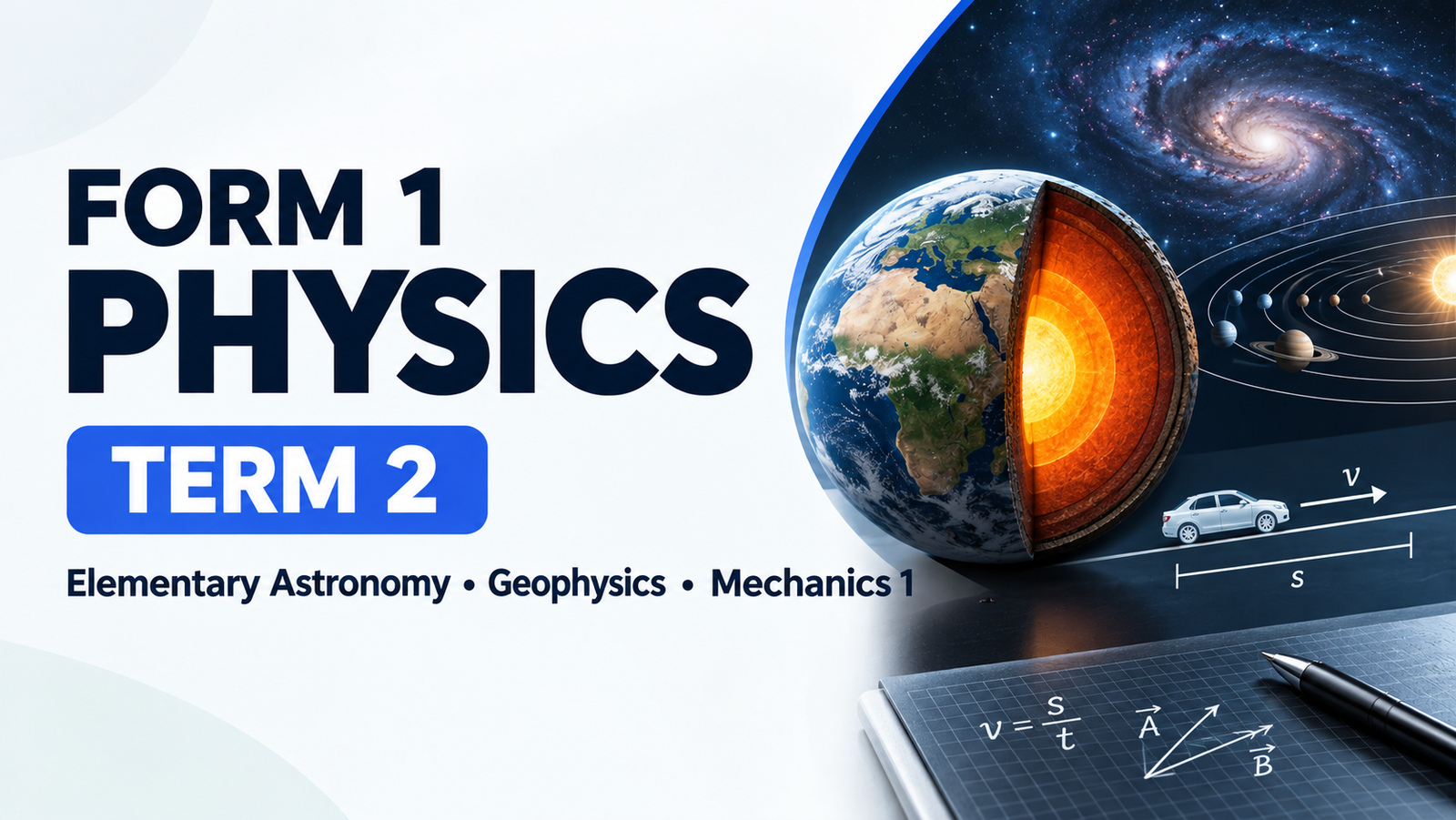
Explore the Universe, Earth and the principles of motion. This course introduces elementary astronomy, geophysics, vectors, linear motion, graphs, acceleration and free fall through practical and mathematical applications.
What Will You Learn?
- 🌌 Understand the Universe, planets and basic astronomical phenomena.
- 🌍 Explain the structure and composition of the Earth and its atmosphere.
- ➡️ Distinguish between scalar and vector quantities and determine resultant vectors.
- 📈 Analyse motion using equations, graphs and calculations.
- 🏃 Apply principles of linear motion, reaction time, braking distance and free fall.
Course Content
SECTION 1 — ELEMENTARY ASTRONOMY
Topic 1: The Universe
-
Lesson 1 – The Universe
-
Lesson 2 – Solar system and celestial bodies
-
Lesson 3 – Relative sizes and positions of planets
-
Lesson 4 – Scale models and diagrams
-
Lesson 5 – Astronomical events
-
Lesson 6 – Observing the solar system
-
Lesson 7 – Astronomical tools and technologies
-
Lesson 8 – Space exploration and virtual simulations
Topic 2: Practical Astronomy Activities
-
Lesson 1 – Creating a scale model of the solar system
-
Lesson 2 – Simulating eclipses and planetary motion
-
Lesson 3 – Exploring space using virtual reality
-
Lesson 4 – Using binoculars, telescopes, spectroscopes, drones and satellite imagery
SECTION 2 — GEOPHYSICS
Topic 3: Structure and Composition of the Earth
-
Lesson 1 – Internal structure of the Earth
-
Lesson 2 – Crust, mantle and core
-
Lesson 3 – Density and gravity
-
Lesson 4 – Seismic waves
-
Lesson 5 – Thermal and temperature gradients
-
Lesson 6 – Magnetic fields
-
Lesson 7 – Radiative transfer
-
Lesson 8 – Rock samples and Earth’s composition
Topic 4: Earth’s Internal Structure — Practical Activity
-
Lesson 1 – Creating a scale model of Earth’s layers
-
Lesson 2 – Identifying and comparing rock samples
Topic 5: Structure and Composition of the Earth’s Atmosphere
-
Lesson 1 – Composition of the atmosphere
-
Lesson 2 – Troposphere
-
Lesson 3 – Stratosphere
-
Lesson 4 – Mesosphere
-
Lesson 5 – Thermosphere
-
Lesson 6 – Exosphere
-
Lesson 7 – Humidity and phase transitions
-
Lesson 8 – Temperature and altitude gradients
-
Lesson 9 – Radiative transfer
Topic 6: Atmospheric Layers — Practical Activity
-
Lesson 1 – Creating a scale model of the atmosphere
-
Lesson 2 – Comparing atmospheric layers and their characteristics
SECTION 3 — MECHANICS
Topic 7: Scalar and Vector Quantities
-
Lesson 1 – Scalar quantities
-
Lesson 2 – Vector quantities
-
Lesson 3 – Differences between scalars and vectors
-
Lesson 4 – Examples and applications
Topic 8: Vector Diagrams and Resultant Vectors
-
Lesson 1 – Constructing vector diagrams
-
Lesson 2 – Addition and subtraction of vectors
-
Lesson 3 – Pythagoras’ theorem
-
Lesson 4 – Parallelogram rule
-
Lesson 5 – Graphical determination of resultant vectors
-
Lesson 6 – Everyday applications of vectors
Topic 9: Linear Motion
-
Lesson 1 – Distance and displacement
-
Lesson 2 – Speed and velocity
-
Lesson 3 – Acceleration
-
Lesson 4 – Uniformly accelerated motion
Topic 10: Equations of Uniformly Accelerated Linear Motion
-
Lesson 1 – Using equations of motion
-
Lesson 2 – Solving motion problems
-
Lesson 3 – Applying equations to everyday situations
Topic 11: Motion Graphs
-
Lesson 1 – Distance–time graphs
-
Lesson 2 – Velocity–time graphs
-
Lesson 3 – Acceleration–time graphs
-
Lesson 4 – Interpreting and analysing motion graphs
Topic 12: Reaction Time and Braking Distance
-
Lesson 1 – Reaction time
-
Lesson 2 – Thinking distance
-
Lesson 3 – Braking distance
-
Lesson 4 – Factors affecting stopping distance
-
Lesson 5 – Road safety applications
Topic 13: Free-Falling Bodies
-
Lesson 1 – Falling objects
-
Lesson 2 – Acceleration due to gravity
-
Lesson 3 – Free-fall calculations
-
Lesson 4 – Applications of free fall
Student Ratings & Reviews

No Review Yet
