Form 1 Physics – Term 1
By charlesphiri2020
Categories: Form 1 Physics
About Course
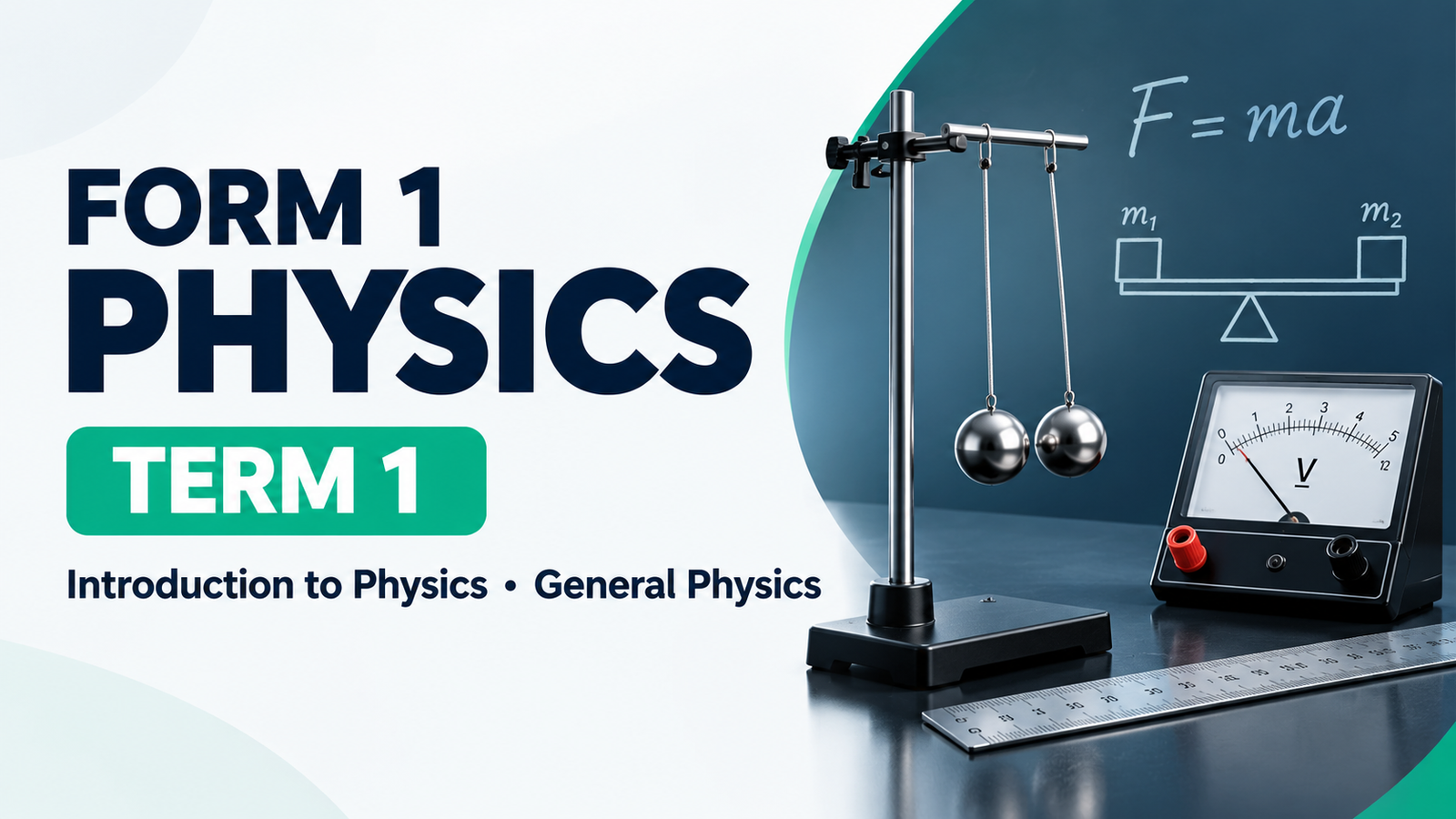
Build a strong foundation in Physics by learning laboratory safety, scientific investigation, physical quantities, measurement, precision and accuracy, density, time, weight, errors, and equilibrium. Through practical activities and real-world applications, learners develop essential skills for observing, measuring, investigating, and explaining physical phenomena.
What Will You Learn?
- Understand the fundamentals of Physics and its applications in everyday life.
- Apply laboratory safety procedures and correctly use common Physics apparatus.
- Conduct basic scientific investigations and communicate findings through scientific reports.
- Make accurate and precise measurements using appropriate instruments and calculate physical quantities such as density.
- Explain measurement errors and the principles of equilibrium in real-world situations.
Course Content
Section 1: Introduction to Physics
Topic 1: Safety Rules
-
Lesson 1: Laboratory Safety and Safety Rules
-
Lesson 2: Practising Laboratory Safety Protocols
-
Lesson 3: Identifying Potential Hazards
-
Lesson 4: Personal Protective Equipment (PPE)
-
Lesson 5: Communicating Safety Information Through Posters
-
Lesson 6: Emergency Response Skills
-
Lesson 7: First Aid in the Physics Laboratory
Topic 2: Waste Management
-
Lesson 1: Identifying Waste Materials
-
Lesson 2: Classifying Waste Materials
-
Lesson 3: Safe Disposal and Waste Management
Topic 3: Apparatus in Physics
-
Lesson 1: Identifying Physics Apparatus
-
Lesson 2: Using Physics Apparatus
-
Lesson 3: Improvising Physics Apparatus
Topic 4: Fundamental Concepts of Physics
-
Lesson 1: What Is Physics?
-
Lesson 2: Fundamental Concepts of Physics
-
Lesson 3: Branches of Physics
-
Lesson 4: Scientific Methods in Physics
Topic 5: Applications of Physics
-
Lesson 1: Physics in Everyday Life
-
Lesson 2: Identifying Applications of Physics
-
Lesson 3: Demonstrating Applications of Physics
Section 2: General Physics
Topic 6: Scientific Investigations
-
Lesson 1: Basic Principles of Scientific Investigations
-
Lesson 2: Designing a Scientific Experiment
-
Lesson 3: Collecting and Recording Data
-
Lesson 4: Writing Scientific Reports
Topic 7: Physical Quantities
-
Lesson 1: Physical Quantities and SI Units
-
Lesson 2: Basic Quantities and Units
-
Lesson 3: Derived Quantities and Units
-
Lesson 4: Prefixes, Multiples and Submultiples
-
Lesson 5: Scientific Notation
-
Lesson 6: Significant Figures
-
Lesson 7: Unit Conversion
Topic 8: Precision and Accuracy
-
Lesson 1: Understanding Precision and Accuracy
-
Lesson 2: Measuring Length Using a Metre Rule
-
Lesson 3: Measuring Length Using Vernier Calipers
-
Lesson 4: Measuring Length Using a Micrometre Screw Gauge
-
Lesson 5: Determining Area
-
Lesson 6: Measuring the Volume of Liquids
-
Lesson 7: Measuring the Volume of Regular Solids
-
Lesson 8: Measuring the Volume of Irregular Solids
-
Lesson 9: Measuring Mass of Solids, Liquids and Gases
-
Lesson 10: Determining Density
-
Lesson 11: Measuring Time Using a Stopwatch
-
Lesson 12: Measuring Time Using a Simple Pendulum
-
Lesson 13: Factors Affecting the Period of a Simple Pendulum
-
Lesson 14: Measuring Weight Using a Spring Balance
-
Lesson 15: Precision Errors
-
Lesson 16: Accuracy Errors
Topic 9: Equilibrium
-
Lesson 1: Understanding Equilibrium
-
Lesson 2: Centre of Mass
-
Lesson 3: Stable Equilibrium
-
Lesson 4: Unstable Equilibrium
-
Lesson 5: Neutral Equilibrium
-
Lesson 6: Equilibrium in Real-World Situations
Student Ratings & Reviews

No Review Yet
